Showing posts with label culture. Show all posts

Friday, 14 June 2024

Odia Raja - Meaning and Significance | Banaste Dakila Gaja

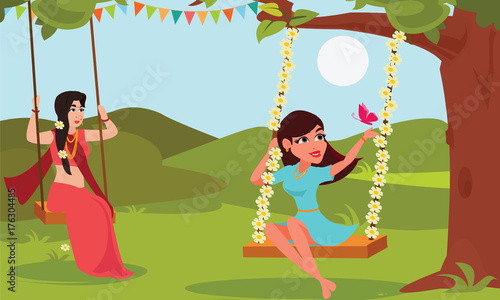
 Young woman playing swings tied on tree branches. Raja Parba or ...


Banaste Dakila Gaja, Barasa Ke Thare Asichi Raja,
Asichi Raja lo Gheni Nua Saja Baja... so the old Odia folksong on Raja goes.

The Raja festival is upon us. We know it and celebrate it as three days of fun, joy, celebrations, new clothes, home cooked pitha, preceded by days of shopping for new clothes and ingredients.

The Raja festival is the day of the year when the earth weeps tears of joy as its dry soil is drenched with the first monsoon rains.  It is during the time of Mithuna Sankranti, which is when the first rains of monsoon strike Odisha. There is also an allusion to the menstrual cycle of young girls of age in the festivities that occur during Raja. While girls have their periods every month, Mother Earth has hers every year.

The festival is a tribute to mother Earth and she is given respite these days and not allowed to carry any burden. The traditional Odia family jobs of "kata", bata", "randha", "badha", "boha bahi" are spared to young girls these few days.

The Odia folk song Banaste Aila Gaja means this is the time when the Elephants meet to mate (maithuna) in the forests, elephants which are revered creatures in Hindu anthology and closely related to the Mother Earth.

On the first day of Raja (Pahali Raja) - young unmarried girls are not supposed to work or touch their feet to the ground. Thus the purpose of the swing so that the feet doesnt touch the groud. Girls deck up in jewellery and finery and enjoy the day on the swing or the cot, while having steamed and burnt delicacies like poda Pitha, and largely food that has not been cokked on hearth.

The day 2 of the Raja is considered to be the main festival. It falls on the day of the Mithun Sankranti. The girl is considered to be the "Rajaki" or like a princess, puts on alta and other finery.

The Day 3 of Raja is the basi Raja, where the young princess is again allowed to mix with everyone and come down from her throne (doli), take down her fineries.

The days are filled with fun and festivities, shopping, games and cooking competitions.

Looking back at the origins of the festival again;

The three days of Raja correspond to the three days of menstruation where women were said to be untouchables for social and hygienic reasons. As per the scriptures the women were Chandala (Untouchable), Brahmaghatini (hurting) and Rajaki on those days. Rajaki also meant a washerwoman, the day the woman cleans her soiled clothes. And the fourth day when finally the woman is considered to be clean or "Suddha" after taking her bath.

All the above are described in the "Rajaswala Dharma"  or "Religious Duties of Menstruating Women" for women in our ancient texts.

I am heartily thankful for the modern day Raja celebrations without their primitive connotations!

Monday, 26 July 2021

Brahmaputra - Deep and Immersive

 A few days back we had a most defining and immersive experience on a cruise on the Brahmaputra. This was my third cruise across the mighty river in this region.

 We started from Guijjan, a small hamlet near Tinsukia, at 7 am, in a small boat. Our destination was an area called Maili in the upper reaches of Brahmaputra where some wild horses had been sighted by forest people. The journey was supposed to take 4 hours.

 During the rainy season, junglee horses move around, as their original settlement around the Dibru Saikhowa national park is flooded.  The Dibru Saikhowa is fed by the Brahmaputra and Lohit and Dibru and an interlaced galaxy of small and big tributaries. Our boatman informed us that we were going towards the Siang (or Dihang, pronounced as Dehing) River, another of those distributing and feeding tributaries that weave in and out of the main river.

It was raining mildly and the boat ride itself was a joy and full of complexities from encountering riverine life and seeing it close-up. The Rangagora tea estate to the left was one of the first sights on the ride. There had been reports of feral horses sighting there a few days ago, which brought the horses to our mind and was the reason this trip. During heavy rains, the estate gets flooded and some portion of its massive main bungalow stands knee deep in water.

The boat ride seemed to be through one of the last of the remaining pristine areas of the country, wild and untouched. For miles there were just the flooded river banks, with uprooted or submerged trees, deep swathes of  greenery on the banks, with just the drongos, babblers, sparrows, swallows, kingfishers and sometime buffaloes, keeping the boat company.

The feral horses are apparently descendants from horses used by Britishers during the WW2.  A few of them escaped and their tribe has grown in the past 80 years to almost 79 horses. Of course, as in any rare species in India, they are endangered, with poachers and hunters looking for them to sell them as race horses or to resort owners.

As we went on, we came to the Laika village. It is mostly inhabited by the Mishing tribe. The entire village is on stilts with willow fences separating the houses. The residents use the river for all their activities. Boats, kids, fishermen, bathers and just watchers thronged the bank. The kids were adept at rowing and could be seen on boats and on the muddy field beyond the bank, playing. Many ran around with catapults using mud golis as stones. The houses had goats, cows, vegetable patches and most importantly solar panels to provide the much-needed light at night to keep away wild animals.


Speaking of wild animals, we heard an interesting tale from one of our forest guards about an old lady who was settled in these riverine wilds. Her kids moved away as they grew older but she refused to budge from her home. She was eventually trampled by a herd of elephants while she slept. Whichever area looked a bit destroyed, like trampled grasses, broken poles, solar panels, you knew elephants had been there! And our guide helpfully informed us that people didn’t die from common diseases like diabetes or cancer here. I guess wild elephants and snakes took care to keep the population under control!

As we progressed on our way upstream, we came across a huge banyan tree inland where there was a forest camp and which is a favourite with trekkers. My husband had done some trekking there with a friend, in the dry season, a few months earlier. It was huge and its canopy stretched on for acres.

In between there were forest watch towers and forest guard house boats, which accommodates around a dozen people, parked on the silty banks. One could see the silt and the bank falling off at many places and trees submerged in the partly flooded river. During full floods, the chapori (the riverine plain villages) are totally submerged and the inhabitants move to different areas, in fact they apparently move lowland as the silt gets deposited there!

We picked up a couple of fishermen who were walking upstream. They had their nets at a particular area, which apparently had some particular fish which sells at a huge premium in the market! Most locals moved around with a hatchet, to cut fishing ropes, brushes and bushes, I guess.

The boat got stuck at many mud flats and had to steered and had to steered and manoeuvred by hand and poles. The flats were many a times not visible in the flooded water. Our journey which was to take 4 hours finally ended up taking 5 hours!

Our biggest surprise was a couple of dolphins leaping up at us! We were totally unprepared to encounter the “Gangetic” dolphins which seemed to populate the area.

At 1 pm, after 5 hours of an eventful boatride we reached the Maili forest camp. The guards told us the horses had been sighted 2 days back. So we started on a trek in search of possible sighting of those elusive creatures. Along the way the couple of forest guards who had obligingly accompanied us enquired of fishermen about the possible whereabouts of the horses. After one hour of trekking through deceptive mud flats, brushes, fields, along the river bank, we reached a small hamlet. A couple of kids told us they had seen the horses in the morning at a distance, so we followed them for half a mile to the area where they had last seen the elusive creatures. Obviously they were not waiting for us! We trekked back to the, desolate, two and a half cottage, hamlet, had a round of tea in makeshift cups and from there proceeded to the boat.

5 hours of boat journey and 2 hours (5 miles) of trekking gave us an inside look into the Brahmaputra in Upper Assam like no other! The return journey took just 3 hours as we were going downstream.


Mighty is just one small adjective for the river. It is definitely mighty. And not just in width, breadth and length. It supports a humungous biodiversity that includes natural forest reserves, rare birds and plants, settlements along its bank, livelihoods for people in three countries, tribes that make a living solely out of it, water to the plains, a plethora of sub terranean life including the edible fish that is the staple diet of people whose life it touches and beyond.

I have given some maps to show the location of the Dibru Saikhowa National Park and the place I am talking about.

Dibru Saikhowa Map


Image Source - 
https://environmentandforest.assam.gov.in/information-services/national-park#dib


Image Source - 

https://upsccolorfullnotes.com/brahmaputra-river-and-its-tributaries/

Tuesday, 24 November 2015

The Confluence of Two Cultures - India and Cambodia (Angkor Wat)


Aa Ka Ma Boi, Paana Gua Thoi, Paana Gua Toro, Masaka Dharama Moro


This incantation reverberates on the banks of River Mahanadi on the day of Kartik Purnima as thousands of people descend to the banks to sail paper, straw and bamboo boats celebrating the history of Bali Jatra. The sailing of boats heralds Odisha biggest festival after Rath Yatra - the Bali Yatra at Cuttack.


At the turn of the last millennium, Odisha, or Kalinga as it was known then, was a major sea
faring nation and controlled many of the sea routes for trading in South East Asia. Its
influence spread far and wide, from Sri Lanka to the Malay peninsula, Bali, Sumatra, Cambodia.

One can still witness the many similarites of culture and architecture in Bali and Cambodia with Kalinga. One spectacular result of this confluence of cultures is the World-renowned Angkor Wat temple at Cambodia.

A model of Angkor Wat in Cambodia

As one gets off a bus and looks onto the grand Angkor Wat temple near Siam Rep in Cambodia, one is hit by a sense of absolute déjà vu. It is like staring at a temple from Odisha in a distant land. The surreal feeling continues as one goes deeper into the temple. How can something so similar be created in a land so far off where the features of the people and language are so alien?

The majestic Angkor Wat
Built in the early 12th century AD over an enormous 500 acres compound, Angkor Wat is the centre of a long lost city civilization. The Khymer architecture, as it is known, has obviously evolved from the Indian subcontinent, especially Kalinga, whose influence seems to have been the greatest. The temple structure uncannily mirrors the Odishan temples built between 6th cent - 13th century AD.

The ancient texts of Odisha are full of stories of sailors sailing off during Kartik Poornima, when the tides were favourable, to Bali, Java, Sumatra, Khambuja (Cambodia), Sinhala (Sri Lanka). We celebrate Bali-Jatra to mark the occasion. One can imagine the maritime sailors making their way to far off lands to trade in spices, silk and jewels - drifting to far off Cambodia. In the process, leaving behind a piece of their own culture with every journey back to the homeland. Maybe some settled for longer and started building as per the traditions of home. The stories from back home were woven into the cultural fabric of the lands where these sea farers went into. There has been evidence of Kalinga presence in Funan (ancient Cambodia) from as far back as 3rd century BC. Legend has it that the Funan Kingdom came into being when a prince from Kalinga married a Naga princess. 

Apsaras and other images on the outer walls


Buddhism started its spread from Kalinga when Emperor Ashoka embraced the peace of Buddhism in the 3rd century BC after the Kalinga war. It made its way to the Indo china region and found expression in the culture and architecture of the region. The many evidence of Buddhism in the culture, history and architecture of Odisha is similarly reflected in Cambodia.


The Jagannath temple according to many historians is a result of the intermingling of Buddhism and the tribal ethnic local worship of the Jagannath idol. The peaceful iconic image of Buddha has permeated the original tantric cult of Jagannath to give a widely accepted peaceful and all knowing God to us.


The Angkor Wat which started as a Hindu temple got taken over by the spread of the cult of Buddhism. The original image of Vishnu that formed the main deity of the temple was replaced by an image of Buddha. The Angkor Wat was taken over by Buddhists sometime in the 13-14th century.

Vishnu reposing under the Vasuki is to be found co-existing with Buddha in meditation under a peepal tree. The floral motifs associated with Hindu temples, are widely found in the temples of Angkor.

Like the Avalokiteshwar that we worship in our temples in eastern India, the all pervading
Avatar of Buddha/ Vishnu in the form of avalokiteshwar is also found at Angkor.

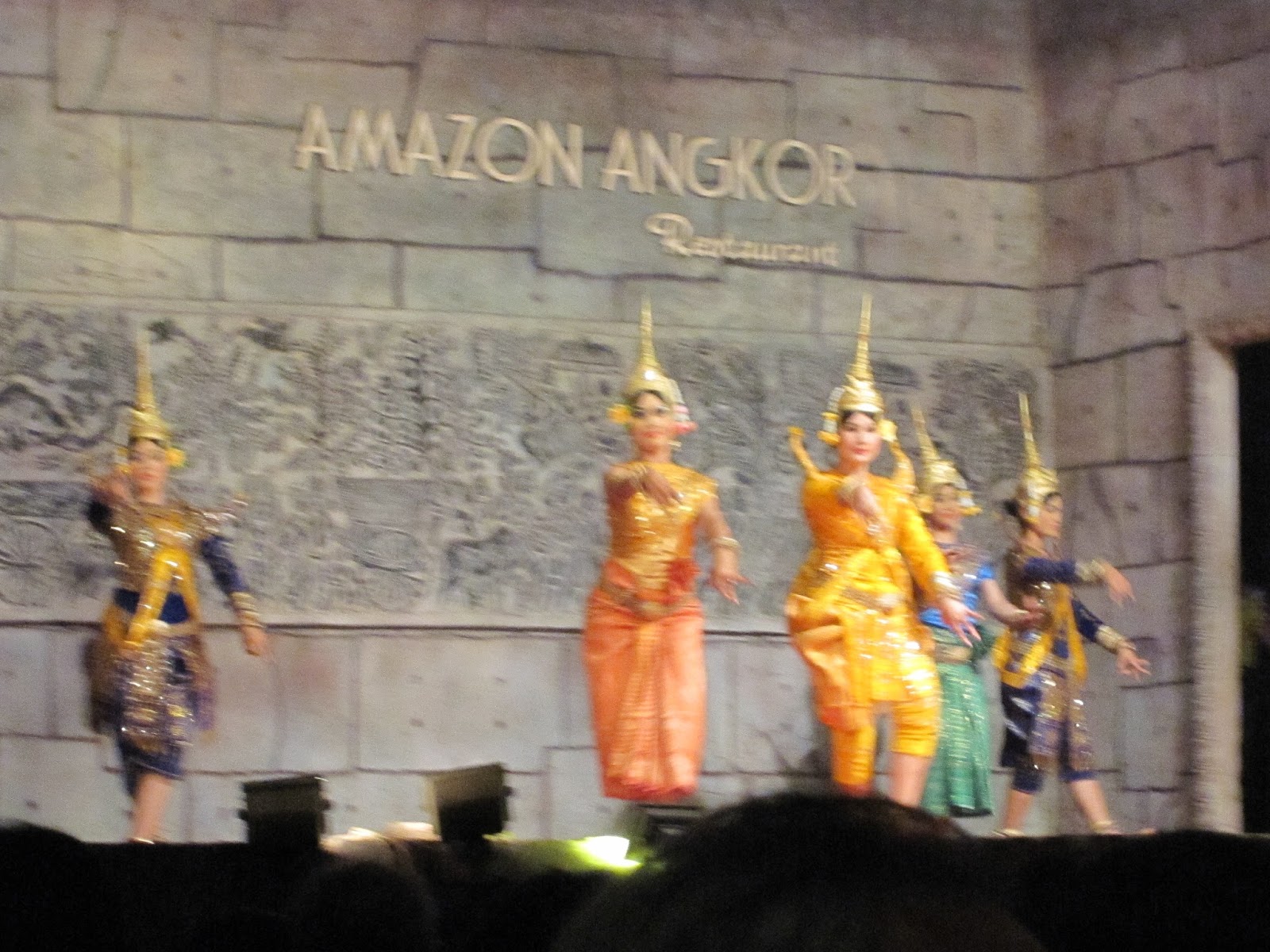
The graceful Apsara dance


Like the temples of Odisha, the Angkor Wat has numerous carved images along its sides. There are hundreds of poses of Apsaras along the walls of the temple. The poses of the apsaras remind one of the various classical dances of the subcontinent. A full apsara dance has many similar mudras or hand movements and poses as Odissi. It is much slower though in enaction. The storylines of
the dance are similarly from the Ramayana or Mahabharata. The churning of the ocean is a scene that is repeated many times throughout the temples in the region, on the railings, bada or pedestal, and the carvings on the side of the temples. The big spires at the end of the halls
are the sikharas that are visible to the naked eyes for miles around. A lotus ribbed head stone completes the sikhara, similar to the temples of the subcontinent. A Lion guards the entrance as in most Hindu temples.


The temples at home, like the Lingaraj or Jagannath temples, are built like a cascade of hills with the pyramidal roofs ascending, with the tallest structure, the "shikhara" over the sanctum sanctorum, at the centre, like a mountain reaching out to the sky. Similarly, the temple structure of Angkor Wat resembles that of a mountain. International historians liken the structure to Mount Meru, the abode of Lord Shiva. Kalinga historians have sometimes noted that the structure could represent Mt Mahendraparvat in Odisha. Mahendraparvat has been mentioned many times in ancient Cambodian history.

Whatever maybe the real story of Kalinga and Khambuja, it is amazing how the cultures merged in such a significant manner in those far off days when the only means of communication was over the waves of the mighty oceans, in roughly constructed sails and wooden boats.

Cultures have clashed and intermingled and carried forward with a new meaning from times immemorial. Even if they are carved in stone. Especially if they are carved in stone. As these mute and vibrant observers of history in stone testify.

Wednesday, 11 June 2014

Oh Kolkata! A Sunday Mid Morning Walk on Park Street

Flurys Park Street Kolkata
Some things in life never change. Like a Sunday morning on Park Street. There maybe an entirely different Government at the Centre. The country's political and social landscape may have changed beyond recognition in the past decade. I might be older(and wiser?) by a decade. More importantly there maybe an entirely different Government in Kolkata with the leftist flavor gone perhaps for ever...but Kolkata in many ways fortunately remains the same!


CLosed Park Street shops
A stroll on Park Street looking for a hair parlour and reviving old memories made me realise how much had gone by in the last 9 years but one could get no inkling of it here! The roads were a virtual empty stretch. In Kolkata's premium shopping and businss district it has been a source of constant amazement to me how it can sleep so utterly on Sunday mornings. No cabs, no lining up at exclusive shops, little pedestrian traffic, no jay walking or hustling to flag down a cab, no street vendors. All the pricey shops lining the Park Street utterly closed with massive shutters down. Its a Sunday in the true sense of the word, a day of no activity. So Worldwide while businesses vie for the weekend traffic and crowd and business, Kolkata preserves its serenity and how!
Park Street on Sunday
 I knew for a fact though things would start moving after one o'clock when the early diners would start coming to the lovely restaurants...the Peter Cats, the Trincas, the Silver Grills and the rest or even before that as late breakfasters would throng into Flurrys. True to my belief, old faithful Flurry's was a flurry of activity...while new entrant Au Bon Pain was virtually empty. There were of course the new additions of KFC and Mc Donalds which looked delightfully empty to my prejudiced self.

 At the end of the street (coming from the Park Circus area) Apeejay House stood steady in its regality (RIP Brother Pauls) while the stylists at A N John remained as snooty as ever! So after cutting my hair at a new parlour (Oxygen), since I couldnt convince the A N John's stylist to cut my hair as per my requirement, I completed my wanderings through the much beloved streets around Park Street with the universal cure for a hot sultry morning with a stop at Saturday Club.