Showing posts with label odisha. Show all posts

Hei Phaguna Tume Song with Lyrics - Akhshaya Mohanty non - album song

 If you are looking for a classic old odia song that shows longing and yearning for a lost love, "Hei Phaguna tume", would be right on top of the list. While "Phaguna" means spring, the song is an allusion to a loved one departing, leaving behind many memories. 


The lyrics of the song Hei Phaguna Tume goes like this.


Hei Phaguna Tume

Gala pare pare

Aneka Jatana ethi (2)

Luha re lekhuchi....


Hear the song "hei phaguna tume" here.


https://www.youtube.com/watch?v=2xup4-sdx0A

Odia Raja - Meaning and Significance | Banaste Dakila Gaja

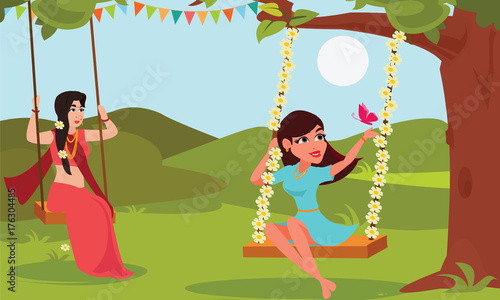
 Young woman playing swings tied on tree branches. Raja Parba or ...


Banaste Dakila Gaja, Barasa Ke Thare Asichi Raja,
Asichi Raja lo Gheni Nua Saja Baja... so the old Odia folksong on Raja goes.

The Raja festival is upon us. We know it and celebrate it as three days of fun, joy, celebrations, new clothes, home cooked pitha, preceded by days of shopping for new clothes and ingredients.

The Raja festival is the day of the year when the earth weeps tears of joy as its dry soil is drenched with the first monsoon rains.  It is during the time of Mithuna Sankranti, which is when the first rains of monsoon strike Odisha. There is also an allusion to the menstrual cycle of young girls of age in the festivities that occur during Raja. While girls have their periods every month, Mother Earth has hers every year.

The festival is a tribute to mother Earth and she is given respite these days and not allowed to carry any burden. The traditional Odia family jobs of "kata", bata", "randha", "badha", "boha bahi" are spared to young girls these few days.

The Odia folk song Banaste Aila Gaja means this is the time when the Elephants meet to mate (maithuna) in the forests, elephants which are revered creatures in Hindu anthology and closely related to the Mother Earth.

On the first day of Raja (Pahali Raja) - young unmarried girls are not supposed to work or touch their feet to the ground. Thus the purpose of the swing so that the feet doesnt touch the groud. Girls deck up in jewellery and finery and enjoy the day on the swing or the cot, while having steamed and burnt delicacies like poda Pitha, and largely food that has not been cokked on hearth.

The day 2 of the Raja is considered to be the main festival. It falls on the day of the Mithun Sankranti. The girl is considered to be the "Rajaki" or like a princess, puts on alta and other finery.

The Day 3 of Raja is the basi Raja, where the young princess is again allowed to mix with everyone and come down from her throne (doli), take down her fineries.

The days are filled with fun and festivities, shopping, games and cooking competitions.

Looking back at the origins of the festival again;

The three days of Raja correspond to the three days of menstruation where women were said to be untouchables for social and hygienic reasons. As per the scriptures the women were Chandala (Untouchable), Brahmaghatini (hurting) and Rajaki on those days. Rajaki also meant a washerwoman, the day the woman cleans her soiled clothes. And the fourth day when finally the woman is considered to be clean or "Suddha" after taking her bath.

All the above are described in the "Rajaswala Dharma"  or "Religious Duties of Menstruating Women" for women in our ancient texts.

I am heartily thankful for the modern day Raja celebrations without their primitive connotations!

A Bowl of Pakhala

Come March, the people of Odisha have to start battling the high and dry heat of an early summer that kind of side steps over what is supposed to be “Basanta Rutu” or Spring season; a season supposed to buffer the summer and be mild, but which slyly gives the state a miss. Summer is all of a sudden upon us, before we have even packed away our winter clothes. We start feeling the departure of winter when the vegetables, fresh beet and carrots and cauliflowers and laukis and peas suddenly start looking dry and withered, then one day suddenly lose their taste. Then comes the loo, the dry wind that the river bed brings in during the mid-day, that is suffocating and all pervasive. Suddenly the swarms of mosquitoes disappear and you know that the temperature is hovering around the 40s mark. But, the real indicator, that Summer is here? The Pakhala. The dish whose images have started doing the rounds of social media in recent years, and so much so, apparently, a day has been dedicated to it! (Whoever had heard of World Pakhala Day even 5 years back!)

Yes, the Pakhala truly heralds the coming of summer to Odisha. A dish, to quench thirst, egalitarian, all-inclusive and stubbornly resistant to change. It is also perhaps the only dish that people can digest in this small rice bowl of eastern India, during the hot season.


PakhalaThe Dish

What is a Pakhala? It is simply the leftover cooked rice dunked in water and taken the next day in its slightly fermented form. The fermentation gives it a kick and sour taste.  The daily wagers, the farmers who toil in the field, the working class, always in need of a fast nutritious dish, relish this simple unpretentious dish in the heat.  The basic Pakhala really doesn’t need much of an accompaniment, just some salt, maybe green chillies and some slices of raw onion. But the dish is equally appreciated across all sections of society. One can add on to the dish and make it as simple or as complicated or traditional as one wishes.

A typical family will have some pan fried vegetables and maybe a boiled potato to go with it. Fish fry, or a side of stir fried prawns is appreciated (most Odia side dishes are stir fried, shallow fried rather than deep fried).  “Badi”, the sun dried dumpling made from lentils, is another favourite accompaniment with the Pakhala. Fried bitter gourd or pumpkin flowers dipped in rice paste and shallow fried are popular anti pastos (or perhaps ante-pakhala?) before one consumes the main bowl.

Pakhala Revival

The timeless dish has had a revival in recent times, thanks to social media and the countless emigrated Odias rediscovering their roots through nostalgia. For people who went to school in the 70s and 80s, nothing completed a day better than to come to a bowl of “Pakhala” after a hot and dusty day at school.

However this acceptance of Pakhala as a regular mainstay of Odia cuisine was not very palatable even a few years back. I remember asking a friend outside Odisha whether they had pakhala at home and the defensive response was “maybe it is taken back in the villages, we don’t have it,"  immediately consigning it to a category as a dish for the rural poor. One cannot really blame the Odia “prabashis” for this type of sentiment. We have been categorized so long as an extremely poor state, that this dish kind of slammed the nail on the coffin of  “Odisha- a poor pakhala eating state”, hence perhaps leading to a reluctance to its acceptance as a proper State cuisine. At least till a few years back.

Thankfully, perhaps with the realization that Pakhala cannot be the worst thing to happen to us, has come an assertion and acceptance of our essential Odia-ness,  and acceptance of all our inherent culture, heritage, quirks, habits, dress codes, dishes, and the ubiquitous and all-encompassing Pakhala in all its glory.

#pakhala #worldpakhaladay


- Sm R

Odisha SuperCyclone 1999

Another day another cyclone. October 29th 1999.

I was at XIMB. There was Xpressions (the Annual Fest) scheduled over the next few days. A perfect opportunity for me to go home to my toddler and spend a few days with him. Little did we guess the events of the next few days. Those were the days without mobile phones or constant weather reports, and analytics that have gone through 1000s of iterations to find the exact flow of a cyclone that is still 750 kms away.

The wind started in the night. The rain started heavy. And it went on and on and on and some more. Over a period of 18 hours the winds over 150 km/hr, howling and the constant downpour didn't stop. The electricity was first to go, with the TV channels. Then, of course, the telephone lines and all communication. Our well-made terrace drainpipes weren't enough to keep off the rain. The stairs became a water cascade and we had a 2 storey waterfall running through the house middle of the day. At first, it was impossible to go out. Then it became impossible to even think about it. Slum dwellers from low lying areas moved into the nearest pucca dwellings, finding refuge in stairwells and porticos. The elegant British era judges' bungalows had their asbestos roofs ripped off. Everyone was equal because everyone was trying to just survive. There were sightings of all kinds of debris including bikes, branches, animals flying about. I remember sitting through some of the day on the leeward side on a balcony for some time wondering when the mango tree on the opposite side of the road would fall. It was way beyond scary.

Two mornings later, things cleared. It brought some scary reports. The city had been in the "eye" of the storm for about 24 hours. A trip out on a scooter saw walls of houses ripped off and trees everywhere. One particularly poignant sight for me was a whole field of headless coconut trees. The horror stories for the two days came trickling in. Reports of half the deer in the deer park near our house having been just thrown about for many metres by the wind. About people washed away by flash floods on the NH, of Paradip being neck deep in water. The stories of mass burials and pyres were to follow a few days later when communication was possible for Jagatsingpur, Paradip, etc. I later heard the stories of my friends from XIMB. The canteen operated for the first day. The next day everyone knew this was not a run of the mill storm. The slum dwellers across the road from our beautiful campus trickled in. They were provided shelter at one of the halls. The students all huddled in the common room since it was impossible to make the trips back and forth from the hostels and the light also had to be shared. Food was rationed and prepared for everyone, including the 100 odd guests from the slums.

On the 4th or 5th day when weather was kind of settled, I made the trip back to the hostel, from Cuttack to Bhubaneswar, with my husband on his scooter. The institute was closed for 15 days, we found out, but the trip was an eye opener on the destruction. The fallen trees, the broken roads, the flash floods, the destroyed fields, the dead cattle. Only one word came to mind. This is what “pralay” looks like.

Things limped back to normal. Water tankers went around the city carrying fresh water. And thankfully those days one used simple candle based water filters so one got drinking water. The electricity was down for about 15 days, if one was lucky. It came back after a month at many places. The Govt was clueless. The effort of everyone apparently was to bring the coastal areas, where the real loss of lives took place, to order. People were homeless, kids orphaned, flood water was everywhere, dead bodies were uncountable. A friend who had gone into the interiors to volunteer said bodies were being piled up and burnt to ward off stench and diseases. Identification was not a priority. And there were hundreds of such funeral pyres happening. CM Chandrababu Naidu chipped in. The volunteers of Andhra came and chopped away trees, cleared debris, put up the bent electric poles and brought some semblance of normalcy to Cuttack. As normal as it can be for a place stripped off most trees and the horrors and helplessness still on the mind.
#supercyclone

If this latest cyclone "Fani" actually strikes at 180-200 km/ hr, be safe, stay indoors, keep a bucket of fresh water and a flashlight handy. Don't count on anything else. Life goes on, or not. And help thy neighbor.

Masai Mara Safari - Day 3 in the Wilds

Day 3 of the Masai Mara Safari, Kenya, Africa On our third day at Masai Mara, we woke up  to see two Hippos fighting out of the water and a ...