Aa Ka Ma Boi, Paana Gua Thoi, Paana Gua Toro, Masaka Dharama Moro
This incantation reverberates on the banks of River Mahanadi on the day of Kartik Purnima as thousands of people descend to the banks to sail paper, straw and bamboo boats celebrating the history of Bali Jatra. The sailing of boats heralds Odisha biggest festival after Rath Yatra - the Bali Yatra at Cuttack.
At the turn of the last millennium, Odisha, or Kalinga as it was known then, was a major sea
faring nation and controlled many of the sea routes for trading in South East Asia. Its
influence spread far and wide, from Sri Lanka to the Malay peninsula, Bali, Sumatra, Cambodia.
One can still witness the many similarites of culture and architecture in Bali and Cambodia with Kalinga. One spectacular result of this confluence of cultures is the World-renowned Angkor Wat temple at Cambodia.
 |
| A model of Angkor Wat in Cambodia |
 | |
| The majestic Angkor Wat |
The ancient texts of Odisha are full of stories of sailors sailing off during Kartik Poornima, when the tides were favourable, to Bali, Java, Sumatra, Khambuja (Cambodia), Sinhala (Sri Lanka). We celebrate Bali-Jatra to mark the occasion. One can imagine the maritime sailors making their way to far off lands to trade in spices, silk and jewels - drifting to far off Cambodia. In the process, leaving behind a piece of their own culture with every journey back to the homeland. Maybe some settled for longer and started building as per the traditions of home. The stories from back home were woven into the cultural fabric of the lands where these sea farers went into. There has been evidence of Kalinga presence in Funan (ancient Cambodia) from as far back as 3rd century BC. Legend has it that the Funan Kingdom came into being when a prince from Kalinga married a Naga princess.
 |
| Apsaras and other images on the outer walls |
Buddhism started its spread from Kalinga when Emperor Ashoka embraced the peace of Buddhism in the 3rd century BC after the Kalinga war. It made its way to the Indo china region and found expression in the culture and architecture of the region. The many evidence of Buddhism in the culture, history and architecture of Odisha is similarly reflected in Cambodia.
The Jagannath temple according to many historians is a result of the intermingling of Buddhism and the tribal ethnic local worship of the Jagannath idol. The peaceful iconic image of Buddha has permeated the original tantric cult of Jagannath to give a widely accepted peaceful and all knowing God to us.
The Angkor Wat which started as a Hindu temple got taken over by the spread of the cult of Buddhism. The original image of Vishnu that formed the main deity of the temple was replaced by an image of Buddha. The Angkor Wat was taken over by Buddhists sometime in the 13-14th century.
Vishnu reposing under the Vasuki is to be found co-existing with Buddha in meditation under a peepal tree. The floral motifs associated with Hindu temples, are widely found in the temples of Angkor.
Like the Avalokiteshwar that we worship in our temples in eastern India, the all pervading
Avatar of Buddha/ Vishnu in the form of avalokiteshwar is also found at Angkor.
The Jagannath temple according to many historians is a result of the intermingling of Buddhism and the tribal ethnic local worship of the Jagannath idol. The peaceful iconic image of Buddha has permeated the original tantric cult of Jagannath to give a widely accepted peaceful and all knowing God to us.
The Angkor Wat which started as a Hindu temple got taken over by the spread of the cult of Buddhism. The original image of Vishnu that formed the main deity of the temple was replaced by an image of Buddha. The Angkor Wat was taken over by Buddhists sometime in the 13-14th century.
Vishnu reposing under the Vasuki is to be found co-existing with Buddha in meditation under a peepal tree. The floral motifs associated with Hindu temples, are widely found in the temples of Angkor.
Like the Avalokiteshwar that we worship in our temples in eastern India, the all pervading
Avatar of Buddha/ Vishnu in the form of avalokiteshwar is also found at Angkor.
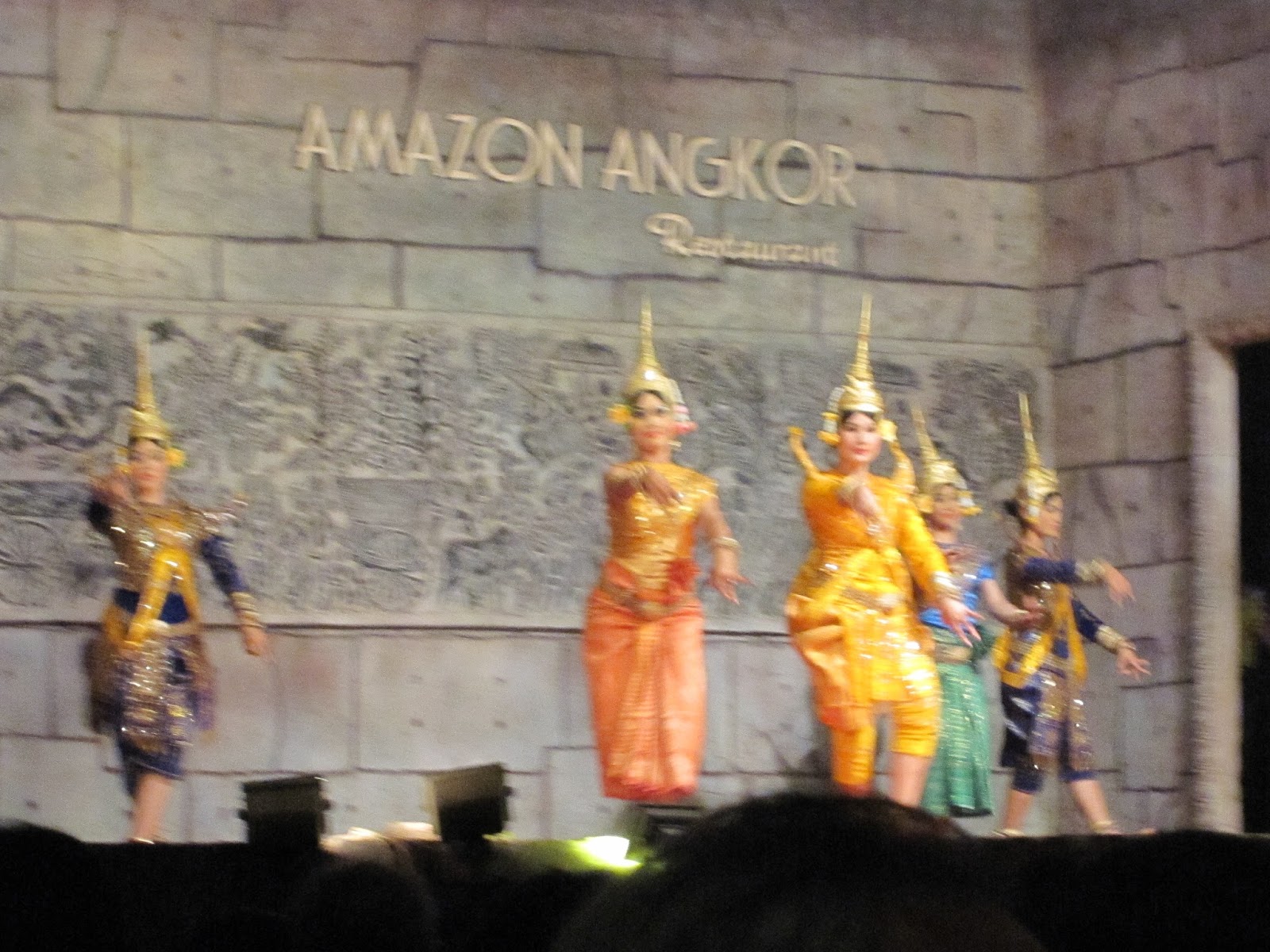 | |
| The graceful Apsara dance |
Like the temples of Odisha, the Angkor Wat has numerous carved images along its sides. There are hundreds of poses of Apsaras along the walls of the temple. The poses of the apsaras remind one of the various classical dances of the subcontinent. A full apsara dance has many similar mudras or hand movements and poses as Odissi. It is much slower though in enaction. The storylines of
the dance are similarly from the Ramayana or Mahabharata. The churning of the ocean is a scene that is repeated many times throughout the temples in the region, on the railings, bada or pedestal, and the carvings on the side of the temples. The big spires at the end of the halls
are the sikharas that are visible to the naked eyes for miles around. A lotus ribbed head stone completes the sikhara, similar to the temples of the subcontinent. A Lion guards the entrance as in most Hindu temples.
The temples at home, like the Lingaraj or Jagannath temples, are built like a cascade of hills with the pyramidal roofs ascending, with the tallest structure, the "shikhara" over the sanctum sanctorum, at the centre, like a mountain reaching out to the sky. Similarly, the temple structure of Angkor Wat resembles that of a mountain. International historians liken the structure to Mount Meru, the abode of Lord Shiva. Kalinga historians have sometimes noted that the structure could represent Mt Mahendraparvat in Odisha. Mahendraparvat has been mentioned many times in ancient Cambodian history.
Whatever maybe the real story of Kalinga and Khambuja, it is amazing how the cultures merged in such a significant manner in those far off days when the only means of communication was over the waves of the mighty oceans, in roughly constructed sails and wooden boats.
Cultures have clashed and intermingled and carried forward with a new meaning from times immemorial. Even if they are carved in stone. Especially if they are carved in stone. As these mute and vibrant observers of history in stone testify.
the dance are similarly from the Ramayana or Mahabharata. The churning of the ocean is a scene that is repeated many times throughout the temples in the region, on the railings, bada or pedestal, and the carvings on the side of the temples. The big spires at the end of the halls
are the sikharas that are visible to the naked eyes for miles around. A lotus ribbed head stone completes the sikhara, similar to the temples of the subcontinent. A Lion guards the entrance as in most Hindu temples.
The temples at home, like the Lingaraj or Jagannath temples, are built like a cascade of hills with the pyramidal roofs ascending, with the tallest structure, the "shikhara" over the sanctum sanctorum, at the centre, like a mountain reaching out to the sky. Similarly, the temple structure of Angkor Wat resembles that of a mountain. International historians liken the structure to Mount Meru, the abode of Lord Shiva. Kalinga historians have sometimes noted that the structure could represent Mt Mahendraparvat in Odisha. Mahendraparvat has been mentioned many times in ancient Cambodian history.
Whatever maybe the real story of Kalinga and Khambuja, it is amazing how the cultures merged in such a significant manner in those far off days when the only means of communication was over the waves of the mighty oceans, in roughly constructed sails and wooden boats.
Cultures have clashed and intermingled and carried forward with a new meaning from times immemorial. Even if they are carved in stone. Especially if they are carved in stone. As these mute and vibrant observers of history in stone testify.


