5 Things to do in the Morning - Health and Fitness Goals

Here are my Top 5 things to do in the morning for a healthy, happy and fit day.

A Black Kite from the window

1. Listen to songs of nature. If you strain your ears in the morning, you will catch the tailorbird, babbler, sparrow, or drongo conversing, if you are lucky. Else there is the pigeon mynah or crow. A few minutes of listening to the titter and tatter sets a tranquil mood for the day. There are are other sounds of nature to catch too like the fall of leaves, rustle of wind or if you are lucky and near the coast, the breaking of the waves. So go ahead and find your songs of nature around you.

2. Sit quietly and reflect. Even a few minutes of absolute solitude helps set the tone for the day as one reaches out to one's core. It helps one figure out what is essential in life and what is not.

3. Observe a creature. This activity again connects us to other beings other than humans. Whether  it is an early bird looking for a worm or a bee looking for honey, a wasp going about building it's nest, little fishes swimming about trying to grasp their feed or even a dog trying to eke out its territory, the activities of other beings is fascinating. You will find every activity is a means to an end. 

4. Take an early bath. I have observed over the years that the people who do this have somehow more time and energy in their hands, are more disciplined and focused in their approach.

5. Mentally plan out the important activities for the day. A few minutes of planning for the day helps in having more time in your hands and important things getting done. Even a bad plan is better than no plan.

Odia Raja - Meaning and Significance | Banaste Dakila Gaja

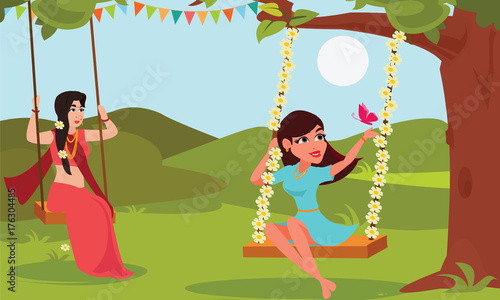
 Young woman playing swings tied on tree branches. Raja Parba or ...


Banaste Dakila Gaja, Barasa Ke Thare Asichi Raja,
Asichi Raja lo Gheni Nua Saja Baja... so the old Odia folksong on Raja goes.

The Raja festival is upon us. We know it and celebrate it as three days of fun, joy, celebrations, new clothes, home cooked pitha, preceded by days of shopping for new clothes and ingredients.

The Raja festival is the day of the year when the earth weeps tears of joy as its dry soil is drenched with the first monsoon rains.  It is during the time of Mithuna Sankranti, which is when the first rains of monsoon strike Odisha. There is also an allusion to the menstrual cycle of young girls of age in the festivities that occur during Raja. While girls have their periods every month, Mother Earth has hers every year.

The festival is a tribute to mother Earth and she is given respite these days and not allowed to carry any burden. The traditional Odia family jobs of "kata", bata", "randha", "badha", "boha bahi" are spared to young girls these few days.

The Odia folk song Banaste Aila Gaja means this is the time when the Elephants meet to mate (maithuna) in the forests, elephants which are revered creatures in Hindu anthology and closely related to the Mother Earth.

On the first day of Raja (Pahali Raja) - young unmarried girls are not supposed to work or touch their feet to the ground. Thus the purpose of the swing so that the feet doesnt touch the groud. Girls deck up in jewellery and finery and enjoy the day on the swing or the cot, while having steamed and burnt delicacies like poda Pitha, and largely food that has not been cokked on hearth.

The day 2 of the Raja is considered to be the main festival. It falls on the day of the Mithun Sankranti. The girl is considered to be the "Rajaki" or like a princess, puts on alta and other finery.

The Day 3 of Raja is the basi Raja, where the young princess is again allowed to mix with everyone and come down from her throne (doli), take down her fineries.

The days are filled with fun and festivities, shopping, games and cooking competitions.

Looking back at the origins of the festival again;

The three days of Raja correspond to the three days of menstruation where women were said to be untouchables for social and hygienic reasons. As per the scriptures the women were Chandala (Untouchable), Brahmaghatini (hurting) and Rajaki on those days. Rajaki also meant a washerwoman, the day the woman cleans her soiled clothes. And the fourth day when finally the woman is considered to be clean or "Suddha" after taking her bath.

All the above are described in the "Rajaswala Dharma"  or "Religious Duties of Menstruating Women" for women in our ancient texts.

I am heartily thankful for the modern day Raja celebrations without their primitive connotations!

Masai Mara Safari - Day 3 in the Wilds

Day 3

On our third day at Masai Mara, we woke up  to see two Hippos fighting, out of the water and a baby Hippo amongst them. The Hippos loved the water so much it was difficult to see them out of it. They are called "jalahasti" in Odia (translated to water elephants) for a reason, I guess.  Dik Diks (little deers) roamed around the camp leaving their traces in between and marking their territory! The robins, starlings and the swallows accompanied us as usual at breakfast. The chef Julius at the camp was a genius and provided us with amazingly well prepped meals every time. That required some commitment since we were the only guests at the resort as it was the middle of the week of an extremely lean rainy season.

The rains ensured that the grass was long, which hindered game viewing. Cheetahs were harder to spot this time of the year. The staff wished us luck in spotting the elusive Rhinos and Cheetahs as we started on the third day of the drive. 


The drive took us to the banks of the Mara River. We went to the Mara Crossing, the place lakhs of zebras and wildebeests cross over from Serengeti and then make their journey back in July - September.  The place is infested with crocodiles during the crossing season as they prey upon the wildebeests crossing the river. We spotted a huge crocodile basking on the shore while a team of Hippos lazed around the other bank. The area during crossings must be a sight to behold teeming with wildebeests, crocodiles, zebras, and hippopotamuses.  We had our lunch on the banks, under a tree. 


The second half of the drive was spent trying to spot a Cheetah. Peter followed the tracks, the movement of topis and impalas, the wind direction, trying to hush up a Cheetah. However, the grass was too long for the low-slung stealthy and shy creatures to be spotted. We did get to see the Rhinos, magnificent two-horned ones, at the Nairobi National Park. We managed to catch pictures of the variety of antelopes and gazelles as they pranced about. We came across a large herd of elephants, including a day-old baby, during our Cheetah search. 

Our adventure was not yet over, though! As we returned and were almost near our camp, Peter slowed down as he saw a herd of Topis on extreme alert. Then we spotted the lions far off, coming out of the trees, towards the Topis. The Topis waited as they tracked the lions with the last one on guard. Peter told us that the lions would not be attacking them as they had been spotted. true to his words, the lions moved towards the antelopes and then veered their course. We watched all this from our open vehicle. Then the lions started coming towards us. As we sat frozen, they majestically moved towards us and veered around the jeep and crossed the road to the open field across. Definitely not a sight to be forgotten in a hurry!

Peter our guide seemed totally unconcerned about the lions being so near. Once when a male lion became slightly aggressive when we came across some lions before lunch, Peter eyeballed him and the lion settled down. I am sure of that though my husband was not inclined to believe me! The Masais, the rangers and guides and the wildlife seem to have some understanding, here.


We made our way back to the small airstrip the next morning bidding our goodbyes to the dancing Thomson gazelles (or dumsum gazelles as we heard our guide say), the shy warthogs, the observing giraffes, the elephants, the wise baboons, the sturdy zebras, knowing we would be back again. 

One last trivia. All the zebras’ prints are different like fingerprints on a human. How cool is that!


Masai Mara Safari - Day 3 in the Wilds

Day 3 On our third day at Masai Mara, we woke up  to see two Hippos fighting, out of the water and a baby Hippo amongst them. The Hippos lov...