Road Trip to Thimpu - Really?

Here I was sitting in the movie hall a few hours back, when I get a phone call. Not sure if it was Bajaj Finance or whoever, I text back asking them to connect later. The caller was persistent and the number didn't look like a mass marketing number. I took the call in the middle of an intense scene (Haha I am joking, the movie was Sonu ka Tittoo Ka Sweety) and the caller said she was Sridevi from Kolkata.
It was interesting enough for me to text back, apologising for not being able to take the call.
Well turned out it was Sridevi, an acquaintance I had made when I was doing the TSD Rally at Kolkata. She gave me some rambling explanation, the gist of which was she needed a navigator for a TSD car rally to Thimpu from Siliguri.
Really?
I like to think I am not one to jump into situations. And I take calm considered decisions. So a few phone calls - to the organizers, to my employers -  and I am ready for Bhutan. In a calm considered manner.
So there's an upcoming car rally to Thimpu come next Thursday.
3 trophies in the space of 2 TSD car rallies has me day dreaming and pumped up for more!
Keep watching this space!

The Kunduli Girl

I was walking home from school
Running along, skipping along
Playing hide and seek
In the deep jungle trails
Loving their many secrets
Chasing the dappled shadows

The bag on my shoulders
My meagre notes and books
Forgotten in my wonder world
A smile on my lips
As I went hush hush after a squirrel
...Stepping on a twig

Was the noise very loud?
What did I hear?
Was that more twigs breaking?
Foolishly, still unconcerned
As I spy the squirrel again,
But not for long...

They creep up
Trample the mossy bed
Chase away the sun's rays
And give a howl of laughter
So I know they are near
With no place to go, No place to hide

Have you seen hyenas
Hunting sniffing playing with their prey
I am the prey
The bloody boots finally leave
With my smile... hunger satiated
Over my trodden bag, broken body

That was not the end
My halting story uttered
Hunted, haunted, deserted
My tale twisted, my virginity plundered
Many times over
I was a pariah, thrown to a hostel away from home

That was still not the end
Woken up at midnight for interrogation
Proven guilty by the learned
Police, doctors, human rights
Women commission, judges
For speaking up means guilty

This girl; How could she be raped
By the very custodians of safety
It has never happened before
She must be lying
The young girl tells big tales
Luscious images of a vivid mind, maybe

A rope to end it all
Distressed, depressed,
Disowned in many ways
An object of shame, pity, distrust
isolation, disgrace
And a hundred days of plunder

But that was again not the end.
The body dragged to the streets
Politician across parties
Fighting for their scrap of glory
Death too doesn't give dignity
While the jungle keeps it's secret, still

The only end is not to be born.

PS
There are some tales which are so sad they need to be told and retold. Everyday we feel we have seen the worst... when actually the worst is around the corner. I would honestly have liked to name this poem "the death of humans".

On the subject of Architecture

I don't think any subject can aspire to be as aspiring or as all comprehensive as architecture.
People think architects only learn to make plans. No. They are taught to have an eye for colour, rhythm, pattern, taught distinctive styles ranging from the medieval to modern, taught climatic conditions and what type of built environment suits each one, taught about materials, old and new, learn about construction and structural techniques ranging from stone, bricks, steel, concrete to present day  new age materials.
History, sociology, botany, a bit of geology all form a part of what they need to know.
Truly, botany? Right! They need to understand plants and know which types provides what kind of shade and goes with which type of environment!
Plus obviously they learn drawing plans, elevations, sections to represent all that they know. Wait. They don't just sit at a computer and start drawing plans. They spend a couple of years practising drafting on a drawing board. Then they learn to translate their thoughts onto the ubiquitous software the language of which again they need to learn simultaneously with their other subjects.
So if you are an architect out there... love thyself is all I can say.

Of Many Colours

Of Many Colours

I wore blue today.
Royal Blue
That is how I feel when I step out under the winter sky
Bluebells on the hedges, blue bougainvilleas with their fluttering dry paper leaves
Ice cold blue with blue bangles
You had better keep your distance from me
So they don’t offend you, my blue veins that stand out
Getting up in the morning, taking my bath at dawn
Washing those left over dishes
And drying those cold clothes
I wore blue today
To feel the glitter in my blue eyes, for I am tired of feeling grey

Is pink my colour?
It gives the colour to my cheeks
When my husband brings me a gift
But more often when my in laws point out my mistakes
I can hide under my pink lips, bangles and ribbons
The blushes turn to anger soon
Again that is pink and can be kept under wraps
Like my pink dupatta which hid my embarrassment
From the repulsive maulings
Of a revered teacher or a co-passenger or a kin
So I wear a brighter pink
To hide behind my anger, desire, pleasure and... sometimes loathing

  
The warm feel of the soft grass
The distant trees forming the skyline of a deserted road
The verdant reflection in the nearby pool
The creepers on the wall reaching out to the sun on the roof
Their tender tendrils seeking a toehold
Warm, new, ever growing
Soaking up the dust mites, carbon
Green is my colour
Born in the tussle between Mother Earth and Sun and its siblings
Green won in tentative steps
Over a billions of years
So how can I wreck it in a few planned moves of destruction over a hundred years?

Bright and Sunny yellow
Nothing keeps it down
Flitting from flowers to flowers on the wings of a butterfly
Or gracing the newly weds in the woven marigold
Cheery and Chirpy but always graceful
Yellow knows
Life is a myth
Nothing lasts and nothing is yours
Like the yellow sun bleaches all it falls on
Time washes away all memories
Except perhaps the fabricated ones, all man made
Yellow is my colour: which holds an eternity in every moment


This poem is inspired by the bright colourful sarees worn by Indian women and relates them to her various moods. I would appreciate your comments and suggestions.

An ode for Self and my 40s Friends (nee Teens!)

(With due apologies to the real poets out there!)


When hormones and BPs make a call
Does friendship go for a stroll? 

Kitty parties, kids and kitchen
Maids, puppies, homework and men
Tie it up with anniversaries and weddings
Bdays, golf parties, work parties and promotions
Parents, arthritis, doctors checkups
Boss, deadlines, budget and the alumni curse

Aunts uncles getting old
As we struggle to make time for them
Those childhood memories get slowly lost
GTs, selfies, whatsapp, games though manage to rule the frame

We still manage to survive the day
With a smile, attitude and reserve at play
Where Everyday is a new day and and Every pic has a new Wrinkle

Those are not worry lines but smile lines 

No anti wrinkle cream is erasing the experience
No doc making us live forever

When finally the mood swings stop and Life settles
Remember we will be too old to play
So let's enjoy the egos and squabbles
And let those thyroid, BP and hormones have their day

Let them just add one more crinkled line of strength
to the bond called friendship; here’s to the day

Let's live it up!

Watching an IPL Match

IPL at Vizag
I have always loved my cricket, so it was a pleasant surprise when my husband asked me to accompany him to a cricket match at Vizag. I have been unaware of the IPL goings on for the past couple of years. I don't really remember the reason the interest just petered off. Was it when Chennai found itself at the centre of the betting scandal? I guess so. I mean when the Champion team's owner's relative was found out being immersed with unsavoury characters with proven involvement in betting scandals and the same owner owns Indian cricket and the captain of the team also captains the country...the relationship between all of Indian cricket and the betting industry and IPL becomes kind of incestuous. Anyways that's a separate story from my IPL watching yesterday!

So, cut off as I was from the game I didn't know what to expect. But to my immense pleasure I found two heroes at the ground at Vizag! And one of them, my all time favorite in cricket, Rahul Dravid, was in the dugout right beneath our Stand! So I had a pleasant couple of hours before the match (yes, we reached two hours early because my husband said what do we do in Vizag otherwise?) doing some Rahul spotting.

Rahul Dravid ..so near!


I hadn't even known that Dravid had moved to Delhi, let alone expecting to find him at Vizag! Wonder what have happened to my other RR favorites, Steve Smith and Shane Watson. But Rahul has got his protege Sanju Samson to Delhi with him. Rahul being simple Rahul and not Dhoni, this strategy was/is bound to fail. I mean, for what reason does one take a Sanju Samson in the middle order against line ups that has huge hitters like Pollard, etc. He is not a strategic big hitter who can make 40 off 12 balls. He is not being used as a wicket keeper, he is not being used as an opener even to hustle some quick runs. That's my un-expert observation about the game.
Now, on to more interesting stuff. Sachin was of course welcomed with a roar. All the glamorous models we see anchoring on TV were not visible. Even the cheerleaders were at the other side of the stadium, away from us. So nothing interesting from that angle. This brings me to wonder,  aren't binoculars allowed in stadiums these days? Would sure have helped some!

Zaheer and Dravid... eye candy
The lounge where we sat was adjacent to a food and waiting lounge. The constant beeline for the drinks and snacks and food became irritating to say the least. The normal humidity of Vizag became suffocating under the spotlights especially when a big black ant crept into my shirt and got mixed up with the sweat lines. The relief from the free steam bath could be had in the air conditioned food lounge if one could be confident enough to leave ones' seats for sometime and one could get some standing area in the lounge amongst the moving food plates and beer mugs. Delhi won the toss, and as was expected, elected to field. Unfortunately for them, Krunal Pandya (whoever is he?) got into a groove and had some really big hits which took Mumbai past 200. The evening was freely peppered with sixes and I kept hoping I would get to catch one and make the TV! 

Delhi decided that enough was enough and decided to end it quickly with a rash of wickets. Fortunately I saw the end coming, being the apostle I am, and plead successfully with my husband to leave the match behind and head home after the fourth Delhi wicket was down. 

So here's to another IPL match. Only this was watched by me and hence made the difference (to only me I guess !)


The Confluence of Two Cultures - India and Cambodia (Angkor Wat)


Aa Ka Ma Boi, Paana Gua Thoi, Paana Gua Toro, Masaka Dharama Moro


This incantation reverberates on the banks of River Mahanadi on the day of Kartik Purnima as thousands of people descend to the banks to sail paper, straw and bamboo boats celebrating the history of Bali Jatra. The sailing of boats heralds Odisha biggest festival after Rath Yatra - the Bali Yatra at Cuttack.


At the turn of the last millennium, Odisha, or Kalinga as it was known then, was a major sea
faring nation and controlled many of the sea routes for trading in South East Asia. Its
influence spread far and wide, from Sri Lanka to the Malay peninsula, Bali, Sumatra, Cambodia.

One can still witness the many similarites of culture and architecture in Bali and Cambodia with Kalinga. One spectacular result of this confluence of cultures is the World-renowned Angkor Wat temple at Cambodia.

A model of Angkor Wat in Cambodia

As one gets off a bus and looks onto the grand Angkor Wat temple near Siam Rep in Cambodia, one is hit by a sense of absolute déjà vu. It is like staring at a temple from Odisha in a distant land. The surreal feeling continues as one goes deeper into the temple. How can something so similar be created in a land so far off where the features of the people and language are so alien?

The majestic Angkor Wat
Built in the early 12th century AD over an enormous 500 acres compound, Angkor Wat is the centre of a long lost city civilization. The Khymer architecture, as it is known, has obviously evolved from the Indian subcontinent, especially Kalinga, whose influence seems to have been the greatest. The temple structure uncannily mirrors the Odishan temples built between 6th cent - 13th century AD.

The ancient texts of Odisha are full of stories of sailors sailing off during Kartik Poornima, when the tides were favourable, to Bali, Java, Sumatra, Khambuja (Cambodia), Sinhala (Sri Lanka). We celebrate Bali-Jatra to mark the occasion. One can imagine the maritime sailors making their way to far off lands to trade in spices, silk and jewels - drifting to far off Cambodia. In the process, leaving behind a piece of their own culture with every journey back to the homeland. Maybe some settled for longer and started building as per the traditions of home. The stories from back home were woven into the cultural fabric of the lands where these sea farers went into. There has been evidence of Kalinga presence in Funan (ancient Cambodia) from as far back as 3rd century BC. Legend has it that the Funan Kingdom came into being when a prince from Kalinga married a Naga princess. 

Apsaras and other images on the outer walls


Buddhism started its spread from Kalinga when Emperor Ashoka embraced the peace of Buddhism in the 3rd century BC after the Kalinga war. It made its way to the Indo china region and found expression in the culture and architecture of the region. The many evidence of Buddhism in the culture, history and architecture of Odisha is similarly reflected in Cambodia.


The Jagannath temple according to many historians is a result of the intermingling of Buddhism and the tribal ethnic local worship of the Jagannath idol. The peaceful iconic image of Buddha has permeated the original tantric cult of Jagannath to give a widely accepted peaceful and all knowing God to us.


The Angkor Wat which started as a Hindu temple got taken over by the spread of the cult of Buddhism. The original image of Vishnu that formed the main deity of the temple was replaced by an image of Buddha. The Angkor Wat was taken over by Buddhists sometime in the 13-14th century.

Vishnu reposing under the Vasuki is to be found co-existing with Buddha in meditation under a peepal tree. The floral motifs associated with Hindu temples, are widely found in the temples of Angkor.

Like the Avalokiteshwar that we worship in our temples in eastern India, the all pervading
Avatar of Buddha/ Vishnu in the form of avalokiteshwar is also found at Angkor.

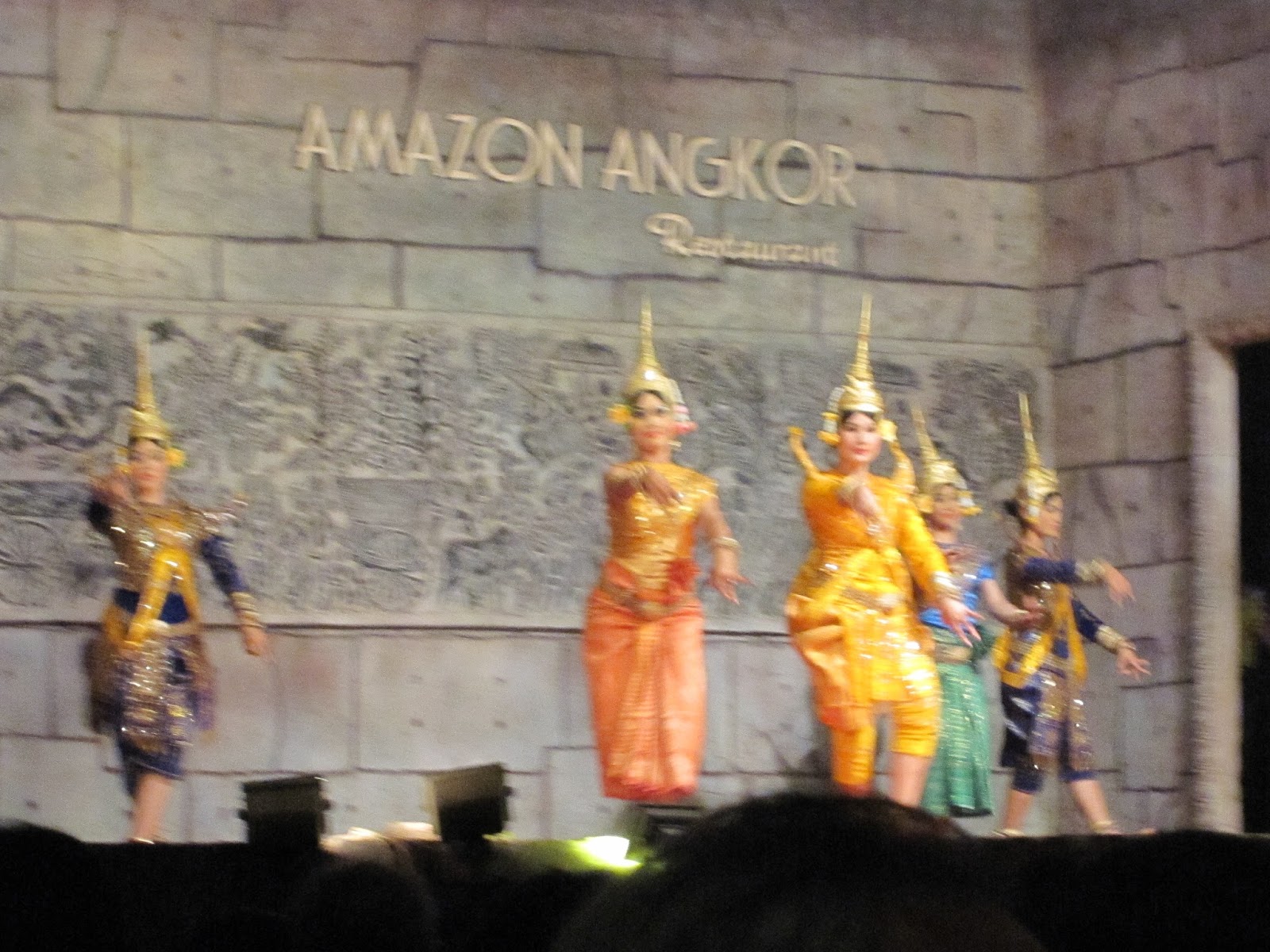
The graceful Apsara dance


Like the temples of Odisha, the Angkor Wat has numerous carved images along its sides. There are hundreds of poses of Apsaras along the walls of the temple. The poses of the apsaras remind one of the various classical dances of the subcontinent. A full apsara dance has many similar mudras or hand movements and poses as Odissi. It is much slower though in enaction. The storylines of
the dance are similarly from the Ramayana or Mahabharata. The churning of the ocean is a scene that is repeated many times throughout the temples in the region, on the railings, bada or pedestal, and the carvings on the side of the temples. The big spires at the end of the halls
are the sikharas that are visible to the naked eyes for miles around. A lotus ribbed head stone completes the sikhara, similar to the temples of the subcontinent. A Lion guards the entrance as in most Hindu temples.


The temples at home, like the Lingaraj or Jagannath temples, are built like a cascade of hills with the pyramidal roofs ascending, with the tallest structure, the "shikhara" over the sanctum sanctorum, at the centre, like a mountain reaching out to the sky. Similarly, the temple structure of Angkor Wat resembles that of a mountain. International historians liken the structure to Mount Meru, the abode of Lord Shiva. Kalinga historians have sometimes noted that the structure could represent Mt Mahendraparvat in Odisha. Mahendraparvat has been mentioned many times in ancient Cambodian history.

Whatever maybe the real story of Kalinga and Khambuja, it is amazing how the cultures merged in such a significant manner in those far off days when the only means of communication was over the waves of the mighty oceans, in roughly constructed sails and wooden boats.

Cultures have clashed and intermingled and carried forward with a new meaning from times immemorial. Even if they are carved in stone. Especially if they are carved in stone. As these mute and vibrant observers of history in stone testify.

Masai Mara Safari - Day 3 in the Wilds

Day 3 of the Masai Mara Safari, Kenya, Africa On our third day at Masai Mara, we woke up  to see two Hippos fighting out of the water and a ...